

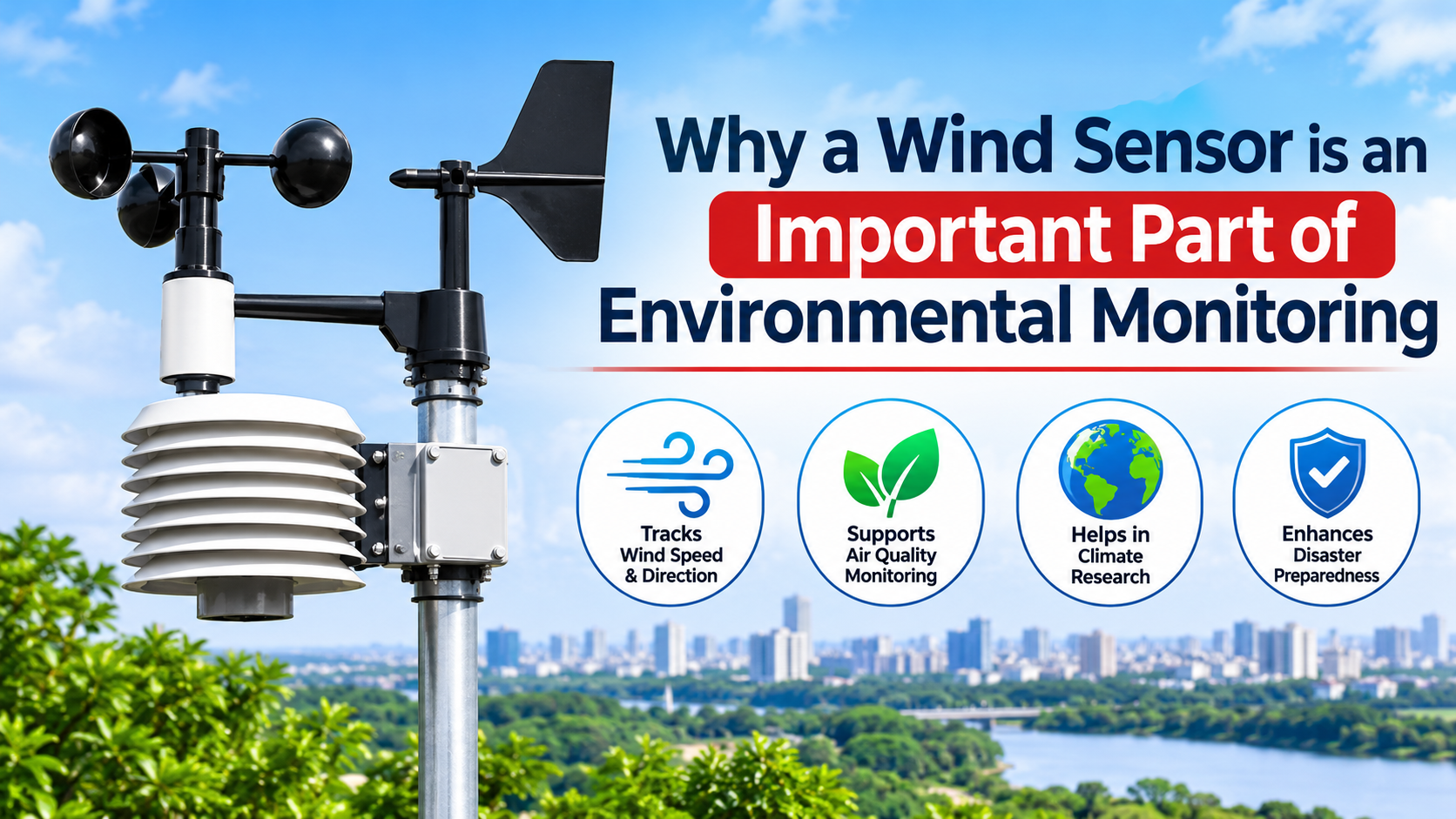
Why a Wind Sensor is an Important Part of Environmental Monitoring
A common piece of equipment used across meteorological and weather monitoring is a wind speed and direction sensor. A correct measurement of wind data reveals a lot about the weather conditions. It can be used to forecast storms, rainfall, cyclones and other weather changes. A wind sensor is important because wind is always working around us. Its pace and direction determine a lot. For instance, it carries pollen, which is essential for plant reproduction. It carries dust and distributes it in the air, affecting the air quality. On a larger scale, it moves the clouds in the sky, and thus it reveals the rain pattern. Thus, the movement of wind has a lot of effect on the agricultural economies, infrastructure, and natural surroundings in all areas. Which Data Is Measured By Wind Sensors Wind movement has two components- direction and speed. A device may be built to measure either one of them or both. Wind Direction It consists of vanes that rotates until it aligns with the direction of wind. The wind direction sensor uses a magnetic rotary encoder, which detects the magnetic field orientation. Wind Speed In the wind speed sensor with cups, there are hemispherical cups around a vertical shaft. The spinning generates electrical pulses to calculate the rotational frequency, which is proportional to wind speed. Ultrasonic Wind Sensors Both the direction and speed components can be measured by an ultrasonic wind sensor or sonic anemometer. It is a device that uses sound instead of mechanical parts. The benefit is that there is no friction and wear because the moving parts are absent. It calculates the horizontal wind speed and complete 360-degree wind direction. The assembly has fixed transducers that measure how fast the sound waves travel between them. It can track micro changes in the wind faster and more accurately. Key Features to Consider in Wind Sensors These are the key features of a reliable wind sensor: System Compatibility Capturing the data is only half of the job. It should be readable by other devices or humans. Communication modules like RS232/SDI-12 and NMEA should be considered for compatibility. Accuracy Checking the accuracy of the device is important because no sensor can be 100 per cent accurate. What matters is how close the results are to an exact measurement. Nearly 2% accuracy can be considered trustworthy. Operating Conditions Check the temperature and humidity range the device can work with. Also look for an IP-protected body for safety against moisture and water. Which One To Choose SS Micro Electronics provide all three types of wind sensors, i.e, wind speed, wind direction and one that measures both. The wind speed sensor is suited for applications where monitoring the wind intensity is the main objective. Wind direction tracks the movement of air so it can be used to assess the origin and study local wind patterns. Ultrasonic wind sensors are used in weather stations, smart agriculture, industrial monitoring, and renewable energy projects for overall wind assessment. Conclusion A wind sensor records the minute or major changes in wind behavior, which can tell a lot about the shifting weather patterns. Climate researchers use it to study air quality from industrial emissions, farmers can use it to plan their agricultural routines and there are many other important applications in environmental studies. If you want to buy wind sensors, choose SS Micro Electronics. Our equipment is designed for high accuracy and is maintenance free.
